Factors Game: A Fun Way to Learn Multiplication and Number Skills
Mathematics becomes easier when learning feels like play. One of the most engaging activities for children and even adults is the Factors game. This educational game helps players understand factors, multiplication, division, and number relationships in an enjoyable way. Instead of memorizing multiplication tables through repetition, players develop mathematical thinking through strategy and problem-solving.
The Factors game is widely used in classrooms because it combines entertainment with education. Teachers often introduce it to students who need extra practice with factors and multiples. Parents also use the game at home to make math more interesting for children.
Whether you are a student, teacher, or parent, understanding how the Factors game works can improve mathematical skills and increase confidence in handling numbers.
What Is a Factors Game?
A Factors game is a number-based activity in which players choose numbers and earn points by selecting factors or multiples of those numbers. The game is designed to strengthen understanding of factorization and multiplication concepts.
The basic goal is simple. Players take turns selecting numbers from a list. When a player chooses a number, they score points based on its factors, while certain factors become unavailable for future turns.
This simple rule creates a strategic challenge because players must think carefully about every move.
The Factors game turns ordinary arithmetic into an exciting competition that encourages critical thinking.
Why the Factors Game Is Important
Many students struggle with multiplication and division because they do not fully understand the relationships between numbers. The Factors game helps solve this problem by allowing players to explore these relationships naturally.
Benefits include:
- Better understanding of factors and multiples
- Improved multiplication skills
- Stronger problem-solving abilities
- Increased logical thinking
- Greater confidence in mathematics
- Enhanced mental calculation skills
Because the game feels like entertainment rather than homework, students often stay engaged for longer periods.
Understanding Factors Before Playing
Before playing the Factors game, it is important to understand what factors are.
A factor is a number that divides another number without leaving a remainder.
For example:
- Factors of 12 are 1, 2, 3, 4, 6, and 12.
- Factors of 20 are 1, 2, 4, 5, 10, and 20.
- Factors of 15 are 1, 3, 5, and 15.
Knowing how to identify factors quickly gives players a major advantage.
Basic Rules of the Factors Game
Different versions exist, but the traditional Factors game usually follows these rules:
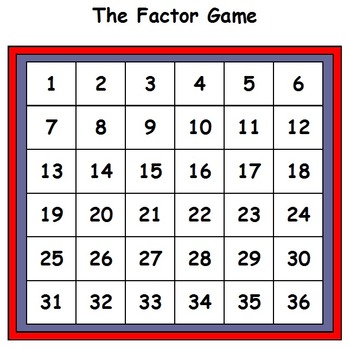
Step 1: Create a Number Grid
Numbers from 1 to 30 or 1 to 50 are placed on a board.
Step 2: Take Turns
Players select one number during each turn.
Step 3: Earn Points
The selected number becomes the player's score.
Step 4: Opponent Receives Factors
The factors of the selected number may become points for the opponent or may be removed from the board, depending on the version being played.
Step 5: Continue Playing
The game ends when no more numbers can be selected.
The player with the highest score wins.
How the Factors Game Improves Multiplication Skills
Multiplication and factors are closely connected. Every multiplication problem creates factors.
For example:
3 × 4 = 12
This means 3 and 4 are factors of 12.
As students repeatedly identify factors while playing, multiplication facts become easier to remember.
The Factors game provides practical experience instead of simple memorization.
Developing Strategic Thinking Through the Factors Game
The game is not only about mathematics. It also encourages strategy.
Players must think about questions such as:
- Which number gives the highest score?
- Which choice leaves fewer opportunities for the opponent?
- Should large numbers be selected early or saved for later?
These decisions help children develop planning and critical-thinking abilities.
The strategic element makes the Factors game more interesting than traditional worksheets.
Why Teachers Love the Factors Game
Teachers often include the Factors game in mathematics lessons because it supports several learning objectives at once.
It helps students:
- Recognize factors and multiples
- Practice multiplication facts
- Improve mental math
- Learn problem-solving techniques
- Participate actively in class
The game also allows teachers to assess students' understanding in a relaxed environment.
Benefits of Playing the Factors Game at Home
Parents can use the Factors game as an educational activity during weekends or holidays.
Advantages include:
Less Screen Time
Children spend time learning rather than watching videos or playing unrelated games.
Family Participation
The game can involve siblings and parents, making learning a shared experience.
Better Academic Performance
Regular practice improves classroom performance and mathematical confidence.
Positive Attitude Toward Math
Games reduce anxiety and make mathematics feel enjoyable.
Different Versions of the Factors Game
Many variations exist to keep the activity exciting.
Single-Player Version
A player tries to achieve the highest possible score independently.
Team Version
Groups work together and discuss strategies.
Digital Version
Many educational websites offer online Factors game activities.
Classroom Tournament
Students compete against classmates in friendly competitions.
Different formats ensure that learners remain interested and motivated.
The Role of Prime Numbers in the Factors Game
Prime numbers play an interesting role in the Factors game because they have only two factors: one and themselves.
Examples include:
- 2
- 3
- 5
- 7
- 11
- 13
Choosing prime numbers requires careful strategy because they provide fewer factor options.
Understanding prime numbers helps players make smarter decisions during the game.
Improving Mental Math with the Factors Game
Mental calculation becomes easier with regular practice.
The Factors game trains players to quickly identify:
- Multiples
- Factors
- Divisibility patterns
- Number relationships
Over time, students become faster and more accurate with arithmetic calculations.
Using the Factors Game in the Classroom
Teachers can adapt the game to different grade levels.
Elementary Students
Use smaller numbers and focus on basic multiplication facts.
Middle School Students
Introduce larger numbers and encourage strategic thinking.
Advanced Learners
Use complex rules involving prime numbers and multiples.
The flexibility of the Factors game makes it suitable for various learning environments.
How the Factors Game Encourages Problem Solving
Every turn presents a puzzle.
Players must evaluate:
- Which numbers remain available
- What factors each number has
- How many points can be gained
- What opportunities remain for opponents
This decision-making process strengthens analytical thinking and problem-solving skills.
Factors Game and Number Sense
Number sense refers to understanding how numbers work and relate to one another.
The Factors game builds number sense by helping students:
- Recognize patterns
- Understand multiplication relationships
- Estimate outcomes
- Think logically about numbers
Strong number sense improves overall mathematical ability.
Common Strategies for Winning the Factors Game
Experienced players often use specific techniques.
Look for Numbers with Many Factors
Numbers like 24 and 36 have numerous factors and may provide strategic advantages.
Avoid Giving Away Easy Points
Consider how your move affects the opponent.
Think Several Turns Ahead
Planning future moves often leads to better results.
Study Number Patterns
Recognizing patterns helps identify strong moves quickly.
The strategic side of the Factors game makes every round different and exciting.
Why Students Enjoy the Factors Game
Many children find traditional math exercises repetitive.
The Factors game changes the learning experience by introducing:
- Competition
- Challenges
- Rewards
- Strategy
- Interaction
Students often become so focused on winning that they forget they are practicing mathematics.
Digital Factors Game Platforms
Technology has made educational games more accessible.
Online versions of the Factors game offer features such as:
- Instant scoring
- Interactive graphics
- Multiplayer options
- Difficulty levels
- Progress tracking
Digital versions are especially useful for independent learning.
How Often Should Students Play?
Regular practice produces the best results.
Playing the Factors game two or three times per week can significantly improve:
- Multiplication speed
- Factor recognition
- Mathematical confidence
- Mental calculation abilities
Short sessions often provide better learning outcomes than long periods of study.
The Educational Value of the Factors Game
Educational games are effective because they combine learning with enjoyment.
The Factors game supports important mathematical concepts including:
- Multiplication
- Division
- Factors
- Multiples
- Prime numbers
- Strategic reasoning
These skills are essential for future mathematical success.
Creating Your Own Factors Game
Making a homemade version is simple.
You need:
- Paper
- A list of numbers
- Pencils
- Score sheets
Creating the game together can make the activity even more engaging for children.
Factors Game for Different Age Groups
Ages 7 to 9
Focus on basic factors and multiplication tables.
Ages 10 to 12
Introduce larger numbers and strategic thinking.
Teenagers
Use advanced mathematical challenges and competitive scoring systems.
The adaptability of the Factors game allows it to grow with the learner.
Why Educational Games Matter
Games encourage active participation, reduce stress, and make difficult concepts easier to understand.
The Factors game demonstrates that mathematics does not have to be boring or intimidating.
Instead, numbers become puzzles waiting to be solved.
Conclusion
The Factors game is much more than a classroom activity. It is a powerful educational tool that helps students understand factors, multiplication, division, and number relationships through play.
By combining strategy with arithmetic, the game develops both mathematical knowledge and critical-thinking skills. Teachers appreciate its educational value, parents enjoy its simplicity, and students love the challenge it provides.
Whether played in school, at home, or online, the Factors game offers an enjoyable way to build confidence in mathematics and strengthen essential number skills.
Frequently Asked Questions
What is a Factors game?
A Factors game is an educational math activity that helps players learn factors, multiplication, and number relationships through strategic gameplay.
Who can play the Factors game?
Children, teenagers, and adults can all enjoy the game because it can be adapted to different skill levels.
How does the Factors game improve math skills?
It improves multiplication, division, factor recognition, mental calculations, and problem-solving abilities.
Is the Factors game suitable for classrooms?
Yes. Many teachers use the game because it encourages participation and makes learning mathematics enjoyable.
Can the Factors game be played online?
Yes. Several educational websites offer digital versions of the game with interactive features.
Why are factors important in mathematics?
Factors help students understand multiplication, division, fractions, and many advanced mathematical concepts.
How often should children play the Factors game?
Playing a few times each week can improve mathematical confidence and strengthen number skills.
Does the Factors game help with critical thinking?
Yes. Players must plan moves, analyze numbers, and make strategic decisions, which improves critical-thinking abilities.